

My grandfather was the architect of my imagination. He spent his Saturdays dragging me through the hushed corridors of our local library—the kind with creaky wooden floors and the smell of old paper that somehow smells like possibility. He showed me that books were doorways, and I became obsessed with collecting keys. I devoured everything: fantasy worlds with dragons and prophecy, love stories that made my chest ache, mysteries that kept me awake past bedtime. In his patient way, he was teaching me that stories matter. That they save you.
Eventually, I tried to build my own worlds. In my teens, before the internet made fan fiction a cultural phenomenon, I was scribbling stories with friends in spiral notebooks. We were creating our own mythologies, too young to know we were doing something subversive and wonderful. (Yes, I’m old enough to remember when sharing stories meant physically passing around folded notebook paper.)
But life had other plans. I discovered I had ADHD in my teens—diagnosed, medicated, confused. And then I spent decades letting it dictate my existence. I became very good at choosing the jobs that paid well over the jobs that fed my soul. I became a master of masking, which is perhaps just a complicated way of saying I disappeared. By my late thirties, I was exhausted in a way that sleep couldn’t fix.
Approaching forty, something shifted. Maybe it was perimenopause (a subject we should talk about more, by the way). Maybe it was simply that I couldn’t anymore—couldn’t life anymore, not like this. My memory became so terrible I forgot I’d ever been diagnosed with ADHD at all. It took forgetting to remember. I went back to a doctor, got medicated properly for the first time, and it was like someone had turned up the brightness on the world.
I’m still astonished I made it this far. But I did. And now—here, at this particular moment in my life—I’m ready. Ready to edit. Ready to share the worlds I’ve been building in the margins of a life that wasn’t really mine.
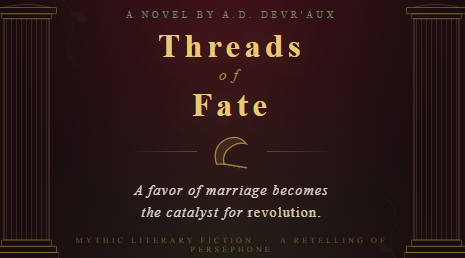
My first novel, Threads of Fate, is a mythic retelling of Persephone’s abduction. But even that description feels small—like describing the ocean as “wet.” It’s a story about reclamation, about the myths we’re told versus the stories we live, about finding yourself in the spaces between what was done to you and what you choose to become. And there are more worlds waiting.
I’m thrilled to share this journey with you. Follow along for glimpses into the work in progress, new content, and the occasional rambling about writing, mythology, and what it means to finally become yourself.
 A.D.Devr'aux Author
Leave a comment